
IRISH PARIS
Le deuxième sexe

Irish actresses, dancers and ladies who can be broadly defined as ‘demi-mondaines’ made their appearance on the Paris scene during the 18th and 19th centuries. As the favourite mistress of King Louis XV for a time, Marie-Louise O’Murphy (‘Louison’ or ‘Morphise’, born in Rouen of Irish parents) was the one who came closest to power. The king, who had a special liking for young flesh, was first introduced to Louison in the summer of 1752, when she was 13 —reputedly after he had seen François Boucher’s nude painting of her. Four years later, she bore him a daughter. Louison, born in Rouen of Irish parents, was eventually dropped from the king’s rota of bed companions, but managed to marry into the provincial nobility while maintaining an address in Paris. Louison was imprisoned for a time during the French Revolution but survived and died in Paris in December 1814 at the ripe old age for the time of 77.
Two other Irish interlopers turned up in the French capital some years later. One was Limerick-born Eliza Rosanne Gilbert (better known under her stage name as ‘Lola Montez’). After a failed marriage, she arrived in the city in 1844, apparently on foot of composer Franz Liszt’s promises of a position as a dancer with the Paris opera. With reviews of her dancing abilities somewhat mixed, the Irishwoman paid more attention to her career as a courtesan and had affairs with a series of influential men. After one of them, the newspaper owner and editor Alexandre Dujarier, was killed in a duel, she left for Bavaria, where she claimed she was mistress to the elderly King Ludwig I. By early 1850, Lola Montez was back in Paris with a new husband, but left again in November 1851 and died aged 40 in New York in 1861.
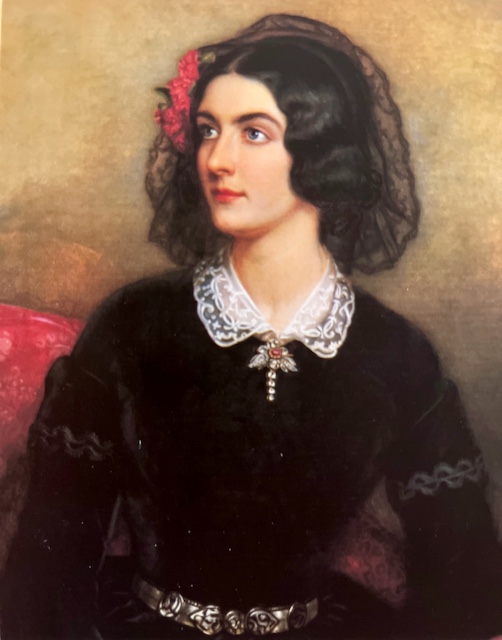
In 1847, three years after Lola Montez, Eliza Lynch from Charleville in County Cork turned up in Paris. She married at a very young age to a French officer but eloped with a Russian in 1853. After he left her, Eliza Lynch resorted to becoming a kind of escort girl. It was in this capacity that she met the Paraguayan general Francisco Lopez, who brought him back to his native land and became caught up in the disastrous War of the Triple Alliance in which Lopez died. Lynch settled back in Paris in the 1870s and died there in July 1886. Her remains were transferred from Père Lachaise cemetery back to Paraguay with full military honours in the early 1960s.
In September 1827, when she was playing the role of Orphelia in Hamlet on the Paris stage, Harriet Smithson, from Ennis in Co. Clare, was spotted by the composer Hector Berlioz. Six years later, the two married at the British Embassy in rue Saint Honoré. While Smithson is said to have inspired Berlioz in some of his work, the marriage floundered over time, with the Irishwoman racking up debts and becoming increasingly “threatened by obesity”. Berlioz and she moved to separate addresses in Paris, leaving the composer to form a long-time liaison with the singer Marie Recio. Interestingly, Recio, Smithson and Berlioz are buried together in Montmartre cemetery.

Joanna Hiffernan, like Lola Montez, hailed from Limerick. She arrived in France in the baggage of the painter James Whistler. The couple met the notorious French painter Gustave Courbet in Normandy in 1865. Whereas Whistler was tiring of Hiffernan, Courbet was captivated by the Irishwoman and quickly had her agree to pose for him (and more?) in Paris in the mid-1860s. For a long time, it was rumoured that Hiffernan was the model in Courbet’s most scabrous painting, L’Origine du Monde, but recent investigations have debunked that notion.
No less sulfurous was the Parisian career of one May (‘Chicago May’) Duignan, born in Edenmore, Co. Longford in 1871. She arrived in Paris in 1901 along with three Irish-American bank robbers who intended to raid the American Express offices beside the Opéra Garnier in the centre of the city. Some accounts claim that ‘Chicago May’ was so drunk that she played no role in the robbery one night in late April, 1901. She herself was adamant she played a central role. Whatever the case, she was arrested some weeks later after paying an ill-advised visit to one of her partners in crime in a Parisian prison. Imprisoned herself, ‘Chicago May’ was amnestied in 1905 and died in Philadelphia in 1929.
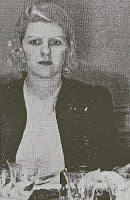
Margaret Kelly (‘Bluebell’) led a longer and definitely more heroic existence. Like Lola Montez, the Dublin-born orphan arrived in Paris with the intention of making a living as a professional dancer. By the early 1930s, she was leading the dance troupe at the famous Folies Bergères cabaret. In 1939, she married a stateless Jewish impresario called Marcel Leibovici. During the Occupation, Marcel went into hiding, leaving Bluebell having to supply him with food bought on the black market while caring for three infant children. Their story became the basis for the classic François Truffaut film ‘Le Dernier Métro’. After a long career as choreographer at the Lido on the Champs Elysées, Bluebell died in 2004 and is buried in Montmartre cemetery.
 IRISH PARIS