
IRISH PARIS
Saints and Churchmen

Christian missionaries from Ireland were having an important impact in France as early as the end of the sixth century, with Saint Columbanus founding the abbey of Luxeuil in eastern France in around 585. Some years later, around 626, Fiacre (or Fiachra, possibly from Kilkenny) turned up in the environs of Paris, where he built a hermitage, priory and guest house for travellers. A cult grew around his burial site in the village of Saint Fiacre, with a story that he could clear weeds by a simple touch of the hand ensuring he became patron saint of gardeners. In this period, one French bishop accused another of being “menteur comme un Irlandais” (a liar like an Irishman). It is not clear whether this was an allusion to Fiachra or another Irish ecclesiastic.
The accusation might have been more fairly thrown at Richard Ferris, a decidedly slippery character. Born in Tralee in 1750, Ferris was suspected of being a double (or triple) agent for the French or the British in the 1790s. Ferris used his connections to spring from a French prison and then have himself appointed by Napoleon superior of the Irish College in Paris where he had studied in the 1770s and been ordained a priest. The appointment displeased the Irish bishops—all the more that he was rumoured to be living with a concubine and fought a duel with a member of the Irish College’s governing council.
Well before Ferris’s scandal-prone tenure, the first Irish College was founded by Dubliner John Lee. Given the renown of Paris as a place of learning, Lee arrived in Paris in 1578 with six student priests with the express intention of creating a “communauté des étudiants irlandais”. But it was not until 1677 that the Irish were finally granted their own permanent seminary, the Collège des Lombards, in the rue des Carmes (of which only the chapel remains).
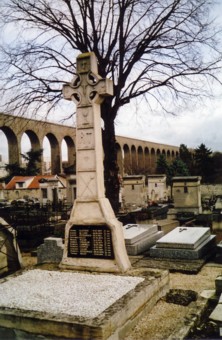
The current Irish College on the Rue des Irlandais was originally set up in the 1770s to provide accommodation for the priests studying in rue des Carmes, but everything was concentrated in rue des Irlandais after the Collège des Lombards was closed in the wake of the French revolution. Throughout the 19th century and up until the Second World War, a steady stream of Irish student priests arrived at the Irish College in Paris. The College had a ‘country house’ in the suburb of Arceuil, south of the city. It has long gone, replaced by a social housing development called the Cité des Irlandais. But the College’s burial plot, surmounted by a restored Celtic cross, can still be seen in the local cemetery.
Henry Essex Edgeworth, known to the French as l’Abbé Edgeworth de Firmont, had his 15 minutes of fame when he was called upon to assist the deposed King Louis XVI on the day of his execution. On the morning of 21 January 1793, Edgeworth (born in Co. Longford in 1745) heard the king’s confession, said mass and then accompanied him through the streets of Paris as he was led to the guillotine on Place de la Concorde. After the execution, Edgeworth miraculously managed to escape the baying crowd, dying some years from typhus while at the court of the exiled Louis XVIII (Louis XVI’s brother) in modern-day Latvia.

St. Joseph’s Church, on the Avenue Hoche, close to the Arc de Triomphe, has long been considered the main Catholic church for English speakers in Paris. It was founded by English and Irish members of the Passionist Order during the 1860s. Some of the earliest residents of St. Joseph’s survived the Siege of Paris and the Commune in 1870-1871, as well as an attempt by the anti-clerical French republic to seize the property in 1900. In the same year, one of the Passionists from St. Joseph’s, Dubliner Cuthbert Dunne, received Oscar Wilde into the Catholic church while the latter lay on his death bed in a Paris hotel. But perhaps the most interesting Irish Passionist who served at St. Joseph’s was Sligo-born Kenneth Monaghan, who helped Allied prisoners on the run from the Germans during the Occupation. Recent research suggests that Monaghan was also deeply enmeshed in Allied intelligence efforts in occupied Paris.
 IRISH PARIS