
IRISH PARIS
The War Years

The Irish Legation faced a huge challenge catering for up to 800 Irish citizens thought to be in France after the French defeat in June 1940. The mainstay of the Legation staff, including the Minister to France Seán Murphy and First secretary Con Cremin, followed the French administration in a tumultuous journey through the country in June 1940 before planting its tent in the Hotel Gallia in Vichy, a spa town where the regime of Maréchal Pétain was established. But the Legation was cut off from northern France, occupied by the Germans. Fortunately, one of Murphy’s predecessors, Count Gerald O’Kelly de Gallagh, was still in Paris, where he ran a wine trade business (he ended up selling wine to the Luftwaffe). From its premises on the Place Vendôme, O’Kelly made frequent sallies out to civilian internment camps in Saint Denis and Besançon to have Irish passport holders released from detention, and dealt with the dozens of Irish without resources left stranded in northern France with no means of getting home. It was also to O’Kelly de Gallagh that Paul Léon confided James Joyce’s papers in 1941.

During the flight through France in June 1940, room was found in one of the Legation cars for Father Patrick Travers (Co. Sligo, 1900), administrator of the Irish College. Travers left the Irish party in Tours, thinking he could get from there to the coast and then find a boat to bring him to England. But this was not to be, leaving him with no option but to find his way back to Paris, where he became the sole resident of the Irish College throughout the Occupation. Food shortages persuaded Travers to turn part of the college grounds into a vegetable garden. With help from the Legation, he managed to ward off various attempts by the French to requisition the College, although he did allow two large halls to be used to store emergency food supplies. On the day that Paris was liberated in August 1944, he strolled over to the square in front of the Panthéon and chatted with an American GI whose parents were from Roscommon.
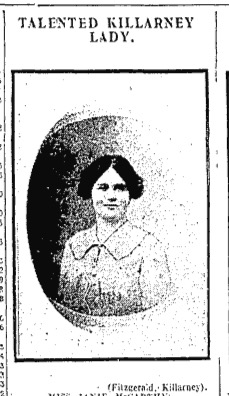
Some Paris Irish joined the Resistance against the Germans in some shape–most prominently Samuel Beckett, who worked with the Gloria SMH network (until it was decimated and Beckett had a close escape from a police raid on his apartment). While Beckett ended up fleeing Paris, Janie McCarthy (Killarney, 1885) remained living at her modest apartment on rue Saint Anne throughout the Occupation. Right from the start, she was closely involved in exfiltrating downed Allied airmen out of the city and supplying military information to London. For her services, this modest lady was awarded the Légion d’Honneur in 1950. There were others of her ilk, most notably Elizabeth (‘Lily’) Hannigan (Dublin, 1919), who worked as a child governess outside Paris. Like McCarthy, she helped downed airmen to escape South and was also a courier for local Resistance units. John Pilkington (Dún Laoghaire, 1905) was on the barricades in August 1944, helping to fight the German garrison in the days before Paris was liberated.
 IRISH PARIS