
IRISH PARIS
Writers and Journalists II
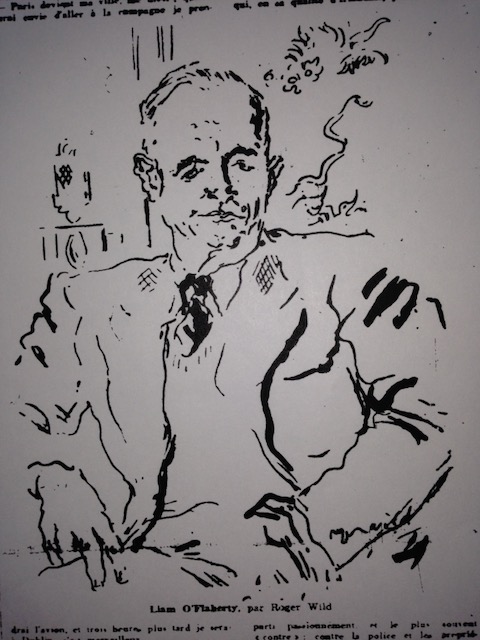
Liam O’Flaherty (Inishmore, 1896) briefly turned up in Paris in 1915, on leave from fighting with the Irish Guards on the Western Front. His stays multiplied in the 1930s as his literary career took off. After a period in the US he went back to Dublin, but understandably “found it uninhabitable” and decided instead to take an apartment in Paris in 1938. He returned to Paris after the war, staying intermittently in the city until the early 1950s, although he continued to make frequent trips to the city thereafter to visit Kitty Tailer, his part-time American lover.
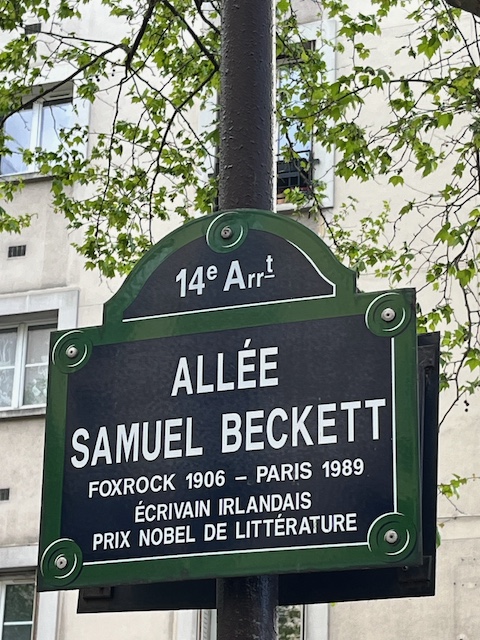
Aged 22, Samuel Beckett won a scholarship from Trinity College to go to the prestigious Ecole Normale Supérieure in 1928 and stayed in Paris until 1930. He was a frequent visitor to James Joyce’s apartment until he was blamed for upsetting Joyce’s schizophrenic daughter, Lucia. More trips to Paris followed, and the city was his home for most of the time from 1937 until his death 52 years later. In January 1938, he came close to death after being stabbed by a pimp on the Avenue d’Orléans (now Avenue Général Leclerc). Despite such experiences, Beckett rushed back to Paris from his summer holidays in Dublin at the start of World War II, stating that he “preferred France in war to Ireland in peace’. Beckett became involved in the French Resistance during the Occupation. After escaping a police round-up, he retreated to southern France in 1942, but was back in the city in early 1945. With money from his mother’s will, he bought a remote retreat for himself in the village of Mollien, east of Paris, while sharing a city apartment (but not a bedroom) with his ‘constant companion’, Suzanne Deschevaux-Dumnesil, at 38, Boulevard Saint-Jacques. The nearby Allée Samuel Beckett was opened in 1999.
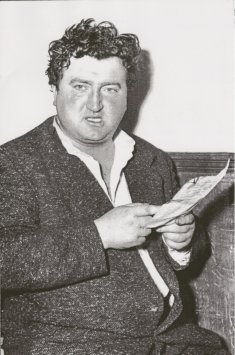
Brendan Behan arrived in Paris in August 1948 as a guest of Samuel Beckett’s cousin. However, Behan was asked to leave after a couple of weeks, forcing him to find his own lodgings and ways to pay for them. He worked several months as a house painter and wrote occasional articles for the Irish Press, while at the same time he tried to offload poems on Sinbad Vail (son of American heiress Peggy Guggenheim), who edited a literary magazine called Points. According to Vail, Behan “drifted all over Paris and in the end, I fear, he bored everybody who wanted to help him”. But Vail did end up publishing some of Behan’s short stories. In 1950, Behan undertook a road trip from Paris to Rome in the company of Anthony Cronin, but only made it as far as the French Alps. As his literary reputation grew and his plays were translated into French, Behan visited Paris on several occasions in the late 1950s and early 1960s. Once, on his way back to Dublin, Behan panicked so badly when the airplane hit a patch of turbulence that the pilot was forced to turn back to Orly Airport. Behan was heard to cry “I’m not ready to die for France” but later claimed that what he had actually said was “I’m not ready to die for Air France”.
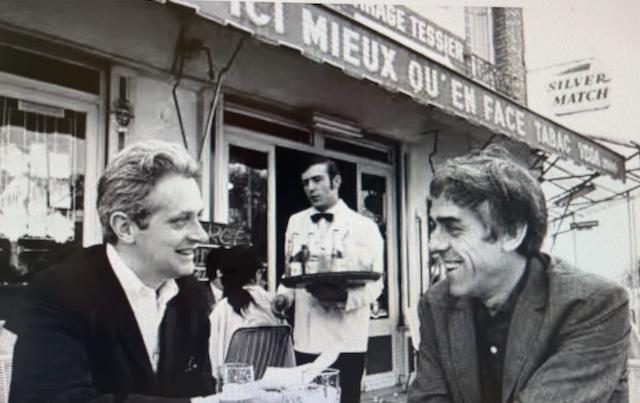
Peter Lennon (Dublin, 1930) quit his job as a bank clerk in Dublin to come to Paris and ended up chronicling France the French arts scene for the Guardian throughout the 1960s. Lennon had a small part in Jacques Tati’s 1967 film, ‘Playtime’—an experience he did not enjoy. But Lennon ventured further into the world of cinema when he directed the film ‘The Rocky Road to Dublin’, a somewhat scattered indictment of the Ireland of the time. This was the last film shown at the May 1968 Cannes film festival before Jean-Luc Godard & co. decided the festival should be closed down in sympathy with the student riots in Paris. Film footage remains of Lennon valiantly pleading for other young film makers to be given a chance to show their film, only to be shouted down by an imperious Godard.
It was probably on his first trip to Paris in the early 1960s that John McGahern met Peter Lennon and it was through Lennon that McGahern met there his first wife, Annikki Laaski. The marriage did not last and caused well-document ructions with Irish officialdom, costing MacGahern his job as a teacher. It was Madeline Green, McGahern’s second wife, who was to keep McGahern connected to the French capital. Her father owned a number of apartments in Paris, including one she and McGahern occupied on and off for many years at 1, rue Christine in the very heart of the Latin Quarter.
 IRISH PARIS